

We don’t pick up a book to watch two people fall in love; we read to see if they can survive the fall. There is a specific, visceral beauty in the moment a character’s heart breaks because they are forced to choose between the person they love and the person they need to become. If you have ever finished a book feeling both exhausted and exhilarated, you understand the magnetic pull of romance novels with deep emotional conflict. It’s not just about the drama. It’s about the transformation. It’s about the ache.
You are likely tired of shallow plots where the only barrier to a happy ending is a simple misunderstanding that could be solved with one honest conversation. You crave high-stakes angst that feels earned. We promise to help you understand why this emotional resonance is so addictive and show you how to find stories that balance intense pressure with a truly believable resolution. We will explore the mechanics of narrative tension and look at how authors create those impossible choices that keep you turning pages until dawn. From the surge of the “romantasy” trend to the raw intimacy of contemporary prose, we are diving deep into the stories that challenge the heart.
Key Takeaways
- Learn to distinguish between external obstacles and internal struggles to find stories where the conflict is woven into the characters’ souls.
- Discover why we crave “the ache” and how high-stakes romance allows us to safely explore intense personal transitions and difficult decisions.
- Master the search for romance novels with deep emotional conflict by identifying specific narrative markers like the proximity rule and high-impact angst.
- Understand how external plot points must trigger internal crises to ensure a story’s resolution feels earned and deeply satisfying rather than just sad.
- Explore the evocative work of Jennifer Westecott and see how Heartbreak Falls delivers the sophisticated, high-stakes tension you have been seeking.
Beyond the Happily Ever After: What Defines Deep Emotional Conflict?
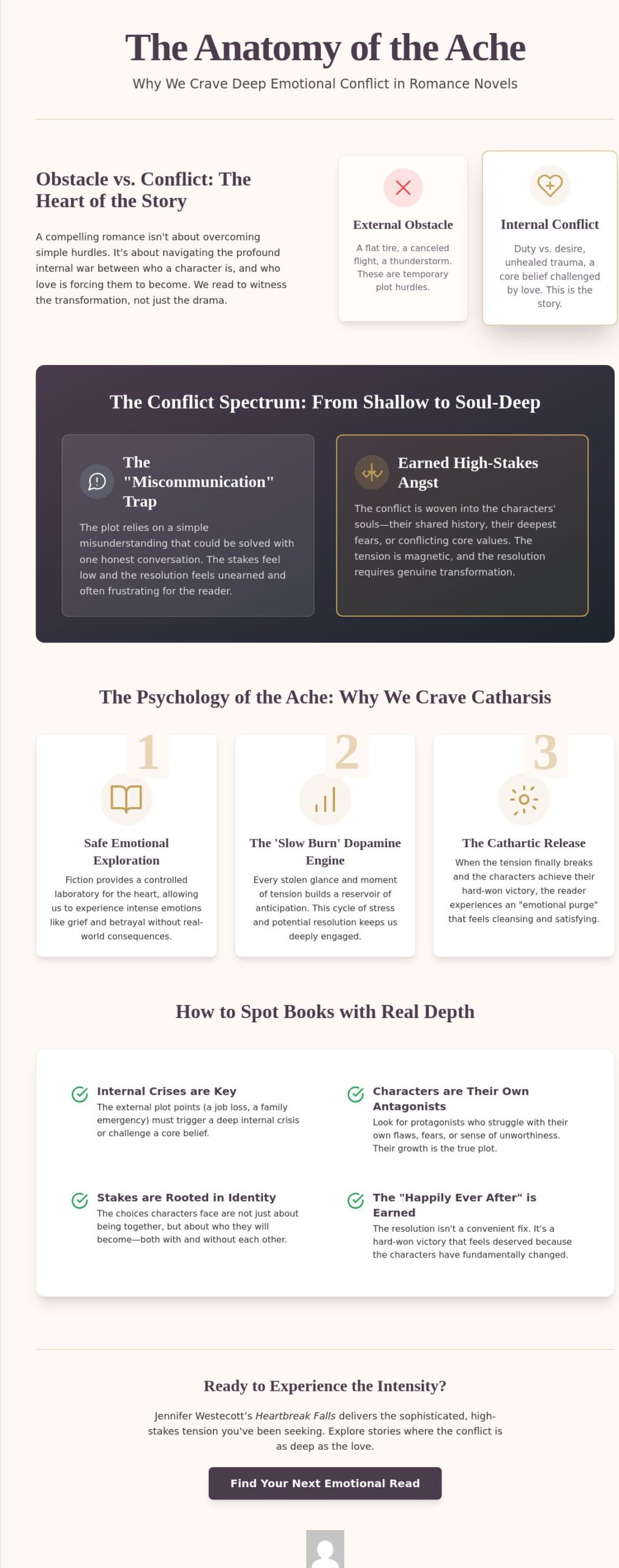
A story is only as strong as the pressure applied to the characters’ hearts. To truly understand the magnetic pull of a modern romance novel, we have to look past the external plot points. It is easy to mistake an obstacle for a conflict. An obstacle is an external event; a thunderstorm that cancels a wedding or a flat tire on a deserted road. These are hurdles. Conflict, however, is internal. It is the silent war between who a character is and who they desperately want to be. We often see readers searching for romance novels with deep emotional conflict because they are tired of surface-level stories. They want the friction that creates real heat.
The ache we crave comes from this friction. It is the visceral feeling of a heart being pulled in two directions at once. When we read about a protagonist who must choose between a safe, predictable life and a love that requires them to shatter their own carefully built armor, we aren’t just looking for drama. We are looking for a mirror of the human experience. Deep emotional conflict is the intersection of vulnerability and impossible choice.
The “Miscommunication” Trap vs. Real Stakes
There is nothing more frustrating than a plot that could be resolved with a thirty-second phone call. Readers crave substance. Real stakes in romance novels with deep emotional conflict are rooted in something far deeper than a simple misunderstanding. They stem from shared history, unhealed trauma, or fundamentally conflicting life goals. When two people are kept apart by their own pasts or their deepest fears, the tension becomes magnetic. It is the difference between a character who simply didn’t hear a voicemail and a character who cannot bring themselves to believe they deserve to be heard at all. These impossible choices drive the narrative forward with an urgency that feels both painful and inevitable.
Internalized Barriers: The Heart as Its Own Enemy
The most compelling stories often feature characters who are their own greatest antagonists. They might struggle with a deep sense of unworthiness or find themselves trapped in the classic battle of duty versus desire. These internalized barriers create a slow burn that feels authentic and raw. They force the characters to undergo a complete internal transformation before they can reach for their partner. When a character finally breaks through their own walls, the eventual HEA (Happily Ever After) feels earned. It isn’t just a convenient ending. It is a hard-won victory over the shadows of the self.
The Psychology of “The Ache”: Why We Crave High-Stakes Romance
Why do we intentionally seek out stories that make our chests tighten and our eyes sting? It isn’t about masochism. It is about the profound psychological benefit of safe emotional exploration. Fiction acts as a controlled laboratory for the human heart. Within the pages of romance novels with deep emotional conflict, we can experience the jagged edges of grief, the sting of betrayal, and the weight of impossible choices without the real-world wreckage. This distance allows us to process our own buried feelings, offering a sense of relief that is hard to find elsewhere.
The biological response to these stories is powerful. A well-executed “slow burn” functions as a dopamine engine. Every stolen glance and brushed hand builds a reservoir of tension. When that tension finally breaks, the result is an “emotional purge” that leaves the reader feeling cleansed. We crave this cycle of stress and resolution because it mirrors the rhythm of our own lives. The most memorable stories are never the ones where everything went right. They are the ones that challenged our comfort zones and forced us to feel something raw.
The Catharsis of Heartbreak and Healing
There is a unique satisfaction in rooting for characters who are starting over after a devastating loss or a life-altering mistake. We don’t just want to see them fall in love. We want to see them find wholeness. This journey from brokenness to healing creates an unbreakable bond between the reader and the protagonist. When a character survives the “ache” and comes out stronger on the other side, it validates our own capacity for resilience. It reminds us that even after the deepest winter, a second act is possible.
Mirroring Reality: Why “Perfect” is Boring
In contemporary romance, the era of the “perfect” hero or heroine is fading. Readers are increasingly drawn to flawed, relatable leads who make mistakes and carry baggage. Perfection is static; it has nowhere to go. But a messy, complicated character provides the perfect canvas for the deep conflict that makes a story resonate. We recognize the “messy middle” of a love story because we have lived it. This is why romance novels with deep emotional conflict feel so vital. They validate our own complex relationship experiences. If you are looking for stories that don’t shy away from these beautiful complications, you might enjoy exploring the emotionally resonant worlds crafted by authors who prioritize the truth of the heart over the gloss of a fairy tale.
Internal vs. External Conflict: Identifying Romance That Resonates
External drama provides the “what” of a story, but emotional conflict provides the “so what.” A car crash, a sudden job transfer, or a family inheritance is just noise if it doesn’t force a character to confront a hidden truth about themselves. In the most compelling romance novels with deep emotional conflict, every outside event serves as a catalyst for internal growth. If a protagonist is offered a dream job in another city, the real story isn’t the move. It is the fear that they aren’t worth staying for, or the terror of leaving the only place where they ever felt safe. This intersection is where the reader truly begins to care.
The “Proximity Rule” remains a classic tool for authors because it strips away a character’s ability to hide. Physical closeness, whether it’s sharing a cabin during a storm or working in the same small office, forces emotional confrontation. You can’t ignore a feeling when the person causing it is standing three feet away. This forced intimacy acts as a pressure cooker for the heart, turning external settings into a stage for internal crises. It is in these tight spaces where the mask finally slips.
The Anatomy of a High-Stakes Choice
An impossible choice is the heartbeat of high-stakes fiction. It isn’t merely picking between two good options. It is a decision where every path leads to a significant, painful loss. Think of the classic tension between long-held family loyalty and personal identity, or the choice between a guaranteed future and a volatile love. Jennifer Westecott often explores these impossible choices to push her characters to their absolute limits. This leads to the “Point of No Return” in a romance arc. This is the moment where a character makes a decision so profound that they can never go back to the person they were before the story began.
Spotting “Earned” Conflict in Your Next Read
How do you know if the angst in your current book is real or just filler? You should look for “earned” conflict. This happens when a character’s reason for staying away makes perfect sense to them, even if it breaks their heart. It feels inevitable rather than forced.
- The Ghost: Is there a past wound or “ghost” that dictates their current behavior and makes their fear feel valid?
- Internal Logic: Does their hesitation stem from a core value or a deep-seated belief about their own worth?
- Growth Requirement: Does the character need to fundamentally change who they are to find happiness, or would a simple change in circumstances solve everything?
A believable resolution requires a shift in the character’s soul, not just a lucky break in the plot. If the conflict vanishes because of a lottery win or a convenient move, the emotional journey wasn’t real. True resonance only comes when the heart does the heavy lifting. You want to see the character struggle, fail, and eventually evolve to earn their happy ending.
Building Your Emotional TBR: How to Spot Books with Real Depth
Finding your next great read shouldn’t feel like a gamble. When you are specifically hunting for romance novels with deep emotional conflict, your first line of defense is the vocabulary used in blurbs and reader reviews. Look for descriptors like “gut-wrenching,” “emotionally charged,” or “intricately layered.” These aren’t just marketing buzzwords. They signal that the author has prioritized the internal journey over a quick, superficial resolution. While the overall U.S. print book market grew by only 1% in 2024, the romance category surged by approximately 9%. This growth is fueled by a sophisticated audience that rejects shallow plots in favor of stories that leave a lasting mark on the soul.
Indie romance authors often lead the charge in this arena. Without the constraints of traditional corporate formulas, these creators take bolder risks with emotional stakes. They explore the darker shadows of the human experience and offer resolutions that feel hard-won. Community reviews are your secret weapon here. Don’t just look for five stars; look for readers who mention “the ache” or “a satisfying payoff.” A book that makes you cry is only half the battle. You need the healing that follows to make the journey worth the emotional investment.
The Power of the Sample Chapter
The first few pages of a book act as an emotional signature. They reveal the author’s register immediately. As you read, pay attention to the prose. Is it evocative? Do the character’s stakes feel immediate and heavy? If you find yourself holding your breath by page three, you’ve found something special. A well-crafted opening doesn’t just set the scene; it establishes the internal tension that will drive the entire story. You can experience the intensity yourself with a free sample chapter of Heartbreak Falls to see how high-stakes tension and polished prose can hook you from the very first sentence.
Genre Blending: Literary Themes in Contemporary Romance
We are seeing a beautiful rise in “literary romance.” These stories prioritize the internal arc and thematic depth over pure trope usage. This shift toward “adult contemporary” storytelling deals with real-world grief, career identity, and the raw passion of second chances. The goal is to find a balance. You want high stakes that challenge the character’s core beliefs, but you never want to lose the romance at the center of the narrative. The best stories in this category prove that love isn’t just a destination. It is the ultimate catalyst for human evolution and the most powerful way to heal an old wound.
Experience the Intensity: Why Jennifer Westecott’s Work is Your Next Obsession
Jennifer Westecott understands that you don’t just want a story; you want an experience. Her writing is characterized by a sophisticated, raw intensity that bridges the gap between a fast-paced page-turner and a deep soul-searcher. If you’ve been searching for romance novels with deep emotional conflict that refuse to settle for easy answers, her work is the destination you’ve been looking for. She approaches each narrative as a “friendly expert,” someone who knows the tropes of the genre intimately but chooses to push them further into the territory of real human vulnerability. It’s polished. It’s evocative. Most importantly, it’s honest.
The magic lies in the balance. While many stories focus only on the heat of attraction, Jennifer focuses on the weight of the characters’ decisions. She invites readers into a shared emotional space where the stakes are high and the outcomes are never guaranteed. This creates a sense of intimacy that feels like a conversation with a confidant. You aren’t just an observer; you are a participant in the character’s journey toward healing and connection. Her prose captures the rhythmic variation of life itself, moving from sweeping, atmospheric descriptions to sharp, high-impact moments that demand your full attention.
The Heart of Heartbreak Falls
Published in September 2025, Heartbreak Falls serves as a masterclass in narrative tension and serves as a primary example of romance novels with deep emotional conflict. It centers on an impossible choice that threatens to shatter the protagonist’s carefully constructed world. This isn’t just about two people meeting; it’s about two souls colliding at a time when everything else is falling apart. The story resonates because the love is “real” in its complexity. The setting is atmospheric and immersive, providing a lush backdrop for the sharp emotional hooks that keep you invested in every page. It is a case study in how passionate connection is often forged in the fire of shared struggle.
Join the Community of Passionate Readers
To follow Jennifer’s work is to join a community that values the psychology of passion. You become part of an exclusive circle of readers who understand why we crave the high-stakes drama of a difficult personal decision. Every update and new release is met with a current of excitement because readers know exactly what they are getting: a story that respects their intelligence and their heart. Looking ahead, future releases promise to lean even further into these themes. You can expect more stakes, more heart, and more of that beautiful ache that makes the eventual resolution feel so profoundly earned. Discover the full portfolio of Westecott Romance Novels and find your next favorite story.
Embrace the Beauty of the Emotional Journey
True resonance in fiction comes from the moments that force us to look inward. The most satisfying stories are those where the external drama serves only to ignite a deeper internal transformation. By seeking out romance novels with deep emotional conflict, you aren’t just looking for a sad story. You are looking for the profound catharsis that only comes from witnessing a character overcome their greatest fears to reach for love. This is the heart of evocative and emotionally resonant storytelling.
Your next great read should do more than just pass the time; it should leave you changed. Whether you are navigating the “messy middle” of a slow burn or witnessing an impossible choice, the payoff is always found in the healing. If you’re ready to dive into a world where the stakes are high and the connection is raw, now is the perfect time to explore the sophisticated depth of Jennifer Westecott’s work. Start your journey into deep emotional romance with a free chapter of Heartbreak Falls. There is a world of intense passion and hard-won happiness waiting for you. Go find the story that speaks to your soul.
Frequently Asked Questions
What is the difference between angst and deep emotional conflict?
Angst is the pervasive mood of tension or dread that hangs over a story, while deep emotional conflict is the specific internal war within a character. You can have angst without a clear cause; however, conflict requires a direct clash between a character’s desires and their core fears. While angst sets the tone, the conflict provides the narrative engine that forces characters to change.
Can a romance novel have a happy ending if the conflict is very dark?
Yes, a happy ending is a non-negotiable requirement of the romance genre. Even in the darkest romance novels with deep emotional conflict, the author must provide a Happily Ever After or at least a Happy For Now. The intensity of the struggle actually serves to make the eventual resolution feel more earned, providing a sense of profound relief and victory for the characters.
Why do I enjoy reading books that make me cry?
You likely enjoy these stories because they provide a safe space for emotional catharsis. Crying over a fictional journey allows you to release pent-up stress and process complex life transitions without any real-world consequences. This “emotional purge” is deeply validating. It reminds us of our own resilience and our capacity to heal even after the most painful experiences.
How do I know if a romance novel has a ‘miscommunication’ trope?
A miscommunication trope is present when the primary obstacle could be solved by one honest conversation or a simple phone call. If the characters are kept apart only because someone overheard half a sentence, it’s likely a shallow plot device. Deep conflict involves barriers like trauma or conflicting life goals that can’t be fixed with just a few words.
What are some common themes in romance novels with deep emotional conflict?
Common themes in romance novels with deep emotional conflict often include the battle between duty and desire, the struggle with unworthiness, and the challenge of starting over after a devastating loss. These stories explore the “ghosts” of the past and how they haunt current relationships. The focus remains on the internal transformation required to move past these barriers and find a genuine connection.
Is Heartbreak Falls considered an angsty romance?
It is definitely considered an angsty, high-stakes romance that prioritizes emotional depth. The story pushes the characters to their absolute limits, forcing them to confront their deepest vulnerabilities. If you enjoy prose that is both polished and raw, this novel delivers the signature intensity that readers have come to expect from Jennifer Westecott’s storytelling style. It is a journey that values the ache.
Where can I find romance books with impossible choices?
You can find these stories by searching for “literary romance” or “angsty contemporary” categories on major retail sites. Indie authors often specialize in these high-stakes narratives because they have the freedom to take bigger risks with emotional intensity. Look for community reviews that mention “the ache” or “earned endings” to find books that truly challenge the heart and offer complex choices.
What is the best way to start reading Jennifer Westecott’s books?
The best way to start is by experiencing her evocative register firsthand with a free sample chapter. This allows you to feel the emotional weight of her prose before committing to the full journey. Beginning with Heartbreak Falls is a perfect choice for readers who want to dive straight into a sophisticated world of passion and the difficult choices that define modern love.