

Why do we intentionally seek out stories that leave us staring at the ceiling at 3 a.m., breathless and weeping? It isn’t just about being sad. We crave emotionally intense romance books because they offer a friction that surface-level stories simply can’t touch. With the romance market generating $1.5 billion annually as of 2026, it’s clear that millions of readers aren’t just looking for a simple happy ending. They’re looking for a transformation. You want a narrative that demands everything from its characters and, by extension, everything from you.
If you’re tired of predictable plots that lack real stakes, you’ve likely felt the frustration of a story that feels thin. There’s a profound difference between a book that’s merely tragic and one that’s truly intense. One is a circumstance; the other is a choice. In this guide, you’ll discover the anatomy of high-stakes romance and find your next deeply moving read that balances raw passion with impossible decisions. From the soaring “Romantasy” hits of 2026 like Onyx Storm to the intimate, high-stakes tension found in Heartbreak Falls, we’re exploring why these complex characters provide the ultimate book hangover and how to find the stories that will stay with you long after the final page.
Key Takeaways
- Learn to distinguish between simple “tear-jerkers” and narratives built on high-stakes vulnerability and deep emotional resonance.
- Uncover the anatomy of an emotional arc and why internal conflict is the secret ingredient in the most successful emotionally intense romance books.
- Identify the specific tropes, from shared history to deep-seated resentment, that create the most gripping and high-stakes romantic tension.
- Master the art of vetting your next read by prioritizing character-driven reviews and using content warnings to ensure the intensity matches your mood.
- Explore how Jennifer Westecott’s Heartbreak Falls serves as a masterclass in the friction between passion and impossible choices.
What Defines Emotionally Intense Romance Books?
What exactly transforms a story from a simple crush into a soul-shattering experience? Emotionally intense romance books aren’t defined by a specific plot point; they’re defined by the sheer weight of the stakes. It’s the moment when a character’s deepest vulnerability is laid bare, and the narrative tension becomes so thick you can practically feel it on your skin. While many stories focus on the charm of a “meet-cute,” these narratives focus on the “can’t-live-without.”
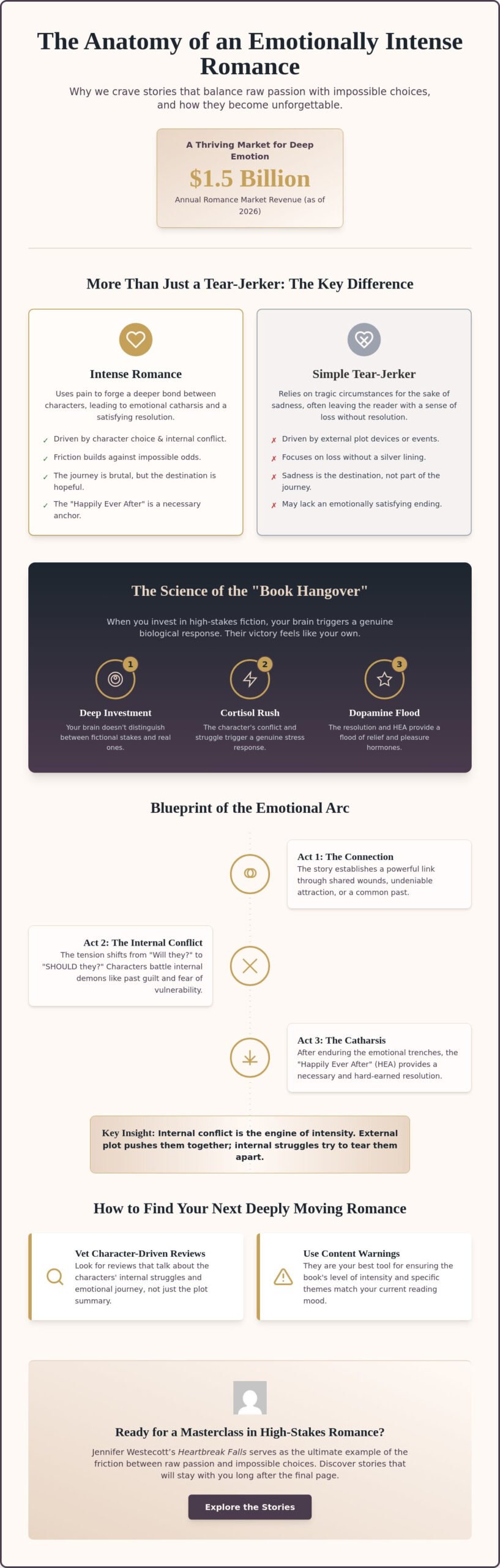
To understand the core of these stories, we first have to look at what defines a romance novel at its most foundational level: a central love story and an emotionally satisfying ending. However, “intensity” pushes those boundaries. It isn’t just about making you cry. A “tear-jerkers” might rely on tragedy for the sake of sadness, but an intense romance uses that pain to forge a deeper bond between characters and the reader. It is the difference between a story that makes you sad and one that makes you ache.
We crave “angsty” stories because they provide a safe space for emotional catharsis. Life is often messy and love is frequently difficult. Seeing characters navigate devastating obstacles and come out on the other side offers a sense of relief that few other genres can match. The Happily Ever After (HEA) isn’t just a trope here; it’s a necessary anchor. Without the promise of hope, the intensity would be unbearable. The HEA provides the resolution our hearts demand after being dragged through the emotional trenches.
The Psychology of the “Book Hangover”
Ever finished a book and felt like you lost a real friend? That’s the “book hangover” in action. When you invest deeply in a character’s journey, your brain doesn’t always distinguish between fictional stakes and real ones. High-stakes fiction triggers a genuine biological response. You experience a rush of cortisol during the conflict and a flood of dopamine during the resolution. We root for these characters because their victory feels like our own personal triumph over hardship.
Intensity vs. Tragedy: Setting Expectations
A common misconception is that an intense romance must end in heartbreak. It doesn’t. In the contemporary romance genre, the journey can be brutal, but the destination remains hopeful. Tragedy is a loss without a silver lining; intensity is the friction of two people fighting for each other against impossible odds. We seek out these stories not to be depressed, but to feel the full spectrum of human connection. It’s about the journey through the fire, not just the ashes left behind.
The Anatomy of an Emotional Arc: From Passion to Choice
Every great love story follows a path, but the most emotionally intense romance books utilize a specific blueprint designed to maximize your investment. It isn’t just about the external forces keeping lovers apart. It’s about the war raging inside them. This three-act structure begins by establishing a connection through shared wounds or undeniable attraction. By the second act, the tension shifts from the “will they, won’t they” to the “should they,” forcing the reader to grapple with the same moral dilemmas as the protagonists.
Internal conflict is the engine of intensity. It’s the fear of repeating a parent’s mistake or the crushing guilt of a past failure. Characters struggle with themselves because they are trying to protect their hearts from a repeat of previous trauma. The “Inciting Incident” in these stories isn’t just meeting a love interest; it’s the moment where duty and desire collide. If you want to see how these arcs unfold in practice, you can explore stories where passion meets impossible choice.
Dialogue plays a critical role in maintaining this tension. To keep a scene from feeling “sappy,” writers focus on subtext and raw honesty rather than flowery prose. It’s the sharp, brief admission that cuts through the noise. When a character finally speaks their truth, it should feel like a dam breaking after years of pressure.
Vulnerability as a Narrative Tool
Perfect characters are boring. We need flaws to feel a connection. Vulnerability is the most powerful tool in a writer’s arsenal because it invites the reader into the character’s private pain. The power of the “unspoken” often carries more weight than a grand declaration. Consider a single sentence that captures a character’s deepest fear: “I am terrified that if you see all of me, you’ll realize you were never actually looking for me at all.” That kind of honesty creates an immediate, visceral bond.
The Pivot Point: The Impossible Choice
Difficult decisions drive the emotional climax. In literary romance, this pivot point often leans into the messy ambiguity of life, while commercial romance ensures the choice leads to a hard-won resolution. Readers forgive flawed characters who make mistakes because we see the agony behind the decision. We understand that the choice isn’t between “good” and “bad,” but between two different kinds of pain. This friction is what makes the eventual resolution feel so earned and deeply satisfying.
Top Tropes That Drive High-Stakes Emotional Romance
Tropes are often dismissed as predictable patterns, but in the world of high-stakes fiction, they serve as the structural bones for devastation. They aren’t just plot devices. They are the pressure cookers that force characters into the impossible choices we’ve explored. Readers seeking emotionally intense romance books often find that these tropes provide the necessary weight to make a story feel real. Whether it is the ghost of a past mistake or the threat of social ruin, these frameworks ensure the emotional stakes remain at a fever pitch. You don’t just want to see people fall in love; you want to see them survive the process.
Second Chance Romance carries a unique brand of pain because it deals with the heavy weight of history. It isn’t just a new love; it’s the reclamation of something lost. Enemies to Lovers thrives on the razor-thin line between resentment and attraction, where every touch feels like a betrayal of one’s own principles. Forbidden Love introduces external pressures that create internal agony, while Love After Loss forces a character to navigate the suffocating fog of grief to find light again. Each trope serves a specific purpose in testing the limits of the human heart through these core emotions:
- Regret: The lingering pain of what was left unsaid years ago.
- Resentment: The fire that burns between rivals who can’t stay away from each other.
- Restraint: The agony of wanting someone you are socially or legally forbidden to touch.
Passion and Regret: The Second Chance Appeal
The “What If” factor is a powerful engine for emotionally intense romance books. We’ve all wondered about the path not taken. Second chance stories allow us to inhabit that regret safely. When a writer utilizes a significant time jump, they heighten the stakes of the reunion. The characters aren’t just fighting for each other; they’re fighting against the versions of themselves that failed the first time. It is a profound way of exploring human connection in romance, proving that some bonds are simply too resilient to stay broken.
The Tension of the “Impossible” Relationship
Why do we love a relationship that seems doomed from the start? External barriers like family feuds, career conflicts, or vast distances heighten the “feels” by creating a constant sense of impending loss. This is where the art of “pining” becomes essential. The longer a character has to wait for a touch or a confession, the more the reader’s anticipation builds. While immediate intensity has its place, the slow-burn tension of an impossible situation often leaves a more lasting mark. It forces characters to prove that their love is worth the sacrifice of everything else they hold dear. It’s about the friction between what the heart wants and what the world allows.
How to Find Your Next Deeply Moving Romance
Finding your next set of emotionally intense romance books requires a bit of detective work. You can’t always rely on a flashy cover or a high-concept blurb to tell you if a story will actually touch your soul. Instead, look closer at the reviews. If readers are describing a book as “character-driven,” it’s a strong signal that the author prioritizes internal growth and emotional stakes over simple plot twists. A plot-driven story might keep you turning pages to see what happens next, but a character-driven one keeps you awake wondering why they are making such devastating choices.
Content warnings are another essential tool in your search. Far from being “spoilers,” they allow you to gauge if the emotional intensity matches your current capacity. Some days you want the raw, gut-wrenching pain of a “tear-jerker,” while other days you need a story that balances that heat with a softer touch. Following authors who lean into “Literary Romance” can also provide a deeper experience. These writers often explore complex themes like legacy, identity, and the long-term consequences of love, ensuring the narrative carries more weight than a standard beach read.
The Power of the Preview
Voice is everything. It is the invisible pulse behind the prose. A first chapter serves as the ultimate litmus test for whether a book will resonate with you or leave you cold. When you read a sample, look for an immediate connection to the protagonist’s internal world. Are the stakes clear? Does the prose feel intimate, as if the author is whispering a secret just to you? If the first few pages don’t make your heart skip, the rest of the book likely won’t either. You can test this emotional resonance right now when you read a free sample chapter of Heartbreak Falls.
Curating Your “Must-Read” List
Digital communities like Reddit and Goodreads are goldmines, but they can be overwhelming. To find the real gems, look for “Auto-Buy” authors. These are creators who have built a reputation for delivering consistent emotional depth, book after book. When you find one, you don’t just read their new release; you devour their entire backlist. If you are a reader who needs a guaranteed safe landing after a rough journey, always check the “HEA” (Happily Ever After) status. Knowing there is hope at the end of the tunnel allows you to fully surrender to the intensity of the journey without fear. If you’re ready to find a story that stays with you, start your journey with a free sample chapter today.
Why Heartbreak Falls is the Ultimate Intense Romance
Jennifer Westecott doesn’t just write love stories; she creates emotional landscapes that demand your full attention. Her signature style is built on the friction between raw passion and the kind of choices that keep you up at night. In the crowded market of emotionally intense romance books, Heartbreak Falls stands out as a masterclass in psychological stakes. It isn’t just about whether the characters end up together. It’s about the cost of that connection and the transformation that occurs when two people are forced to be entirely honest with one another.
Readers are calling this story “gripping” and “unforgettable” for a reason. It doesn’t shy away from the messy parts of human connection that we’ve discussed in previous sections. The novel explores the psychology of difficult life decisions with surgical precision, showing that the most devastating obstacles aren’t always external. Often, they’re the lies we tell ourselves to stay safe. By the time you reach the climax, the characters’ vulnerabilities feel like your own, creating that elusive book hangover we all crave.
A Story of Passion and Impossible Choices
The atmosphere in Heartbreak Falls is heavy with the weight of history and the scent of impending change. From the first page, the emotional weight is palpable, setting a scene where the environment itself mirrors the characters’ internal turmoil. The “Choice” at the heart of the narrative isn’t a simple plot point. It is the defining arc that forces the protagonists to choose between the lives they’ve built and the love they can’t ignore. It’s the ultimate expression of the “impossible choice” that defines high-stakes romance.
This story resonates so deeply with fans of adult contemporary romance because it feels authentic. It mirrors the complexity of real-world relationships where timing, duty, and past trauma often collide with desire. It’s about the bravery required to be truly seen by another person. If you’ve been searching for a narrative that balances high-stakes drama with sophisticated, polished prose, this is the journey you’ve been waiting for. It takes the tropes we love and elevates them into something that feels entirely fresh and deeply personal.
Start Your Journey with Jennifer Westecott
The end of this article is just the beginning of your experience. You can access the full novel and join a community of readers who aren’t afraid to feel deeply. This is an invitation to step into a world where every decision carries weight and every touch matters. Experience a story that stays with you, haunting your thoughts long after you’ve closed the cover. Don’t settle for surface-level stories when you can have something that moves you. Get your copy of Heartbreak Falls today and discover the true meaning of emotional intensity.
Embrace the Power of High-Stakes Romance
We’ve explored how narrative tension and deep vulnerability create the stories that linger in our minds long after the final page. Finding emotionally intense romance books isn’t just about seeking sadness; it’s about witnessing the resilience of the human heart when faced with devastating odds. You now have the tools to vet your next read by looking beyond the blurb to find character-driven journeys that promise a hard-won, satisfying resolution.
If you’re ready to dive into a world of expertly crafted emotional arcs and join a passionate reader community, your next obsession is waiting. You don’t have to take our word for it. Free sample chapters are available to help you test the emotional resonance for yourself before you commit. Discover the passion and heartbreak in Heartbreak Falls and see why Jennifer Westecott’s readers never look at romance the same way again. Let your heart be moved by a story that truly matters. You deserve a book that makes you feel everything.
Frequently Asked Questions
Do all emotionally intense romance books have a sad ending?
No, most emotionally intense romance books actually end with a Happily Ever After (HEA) or at least a Happy For Now (HFN). The intensity comes from the grueling journey and the high stakes the characters face, not from a tragic conclusion. While the narrative might put your heart through the wringer, the genre’s foundation relies on providing a hopeful and emotionally satisfying resolution for the couple.
What is the difference between “angst” and “emotional intensity” in romance?
Angst typically refers to a character’s internal state of brooding, turmoil, or psychological pain, while emotional intensity describes the overall weight and magnitude of the story’s stakes. You can think of angst as the internal weather of a character. Intensity is the earthquake that forces them to make impossible choices. A story can be intense because of external pressures even if the characters themselves aren’t particularly angsty.
How can I tell if a book is too intense for me before I buy it?
Checking the “Content Warnings” provided by the author or looking for the “character-driven” tag in reviews is the most effective way to vet a book’s intensity. Many readers also look for specific sensory keywords in reviews, such as “gut-wrenching” or “soul-shattering.” Reading a Free Sample Chapter is another excellent litmus test to see if the author’s emotional voice and the story’s pacing align with your current comfort level.
Why do people enjoy reading romance books that make them cry?
People seek out these stories for the profound sense of emotional catharsis they provide in a controlled, safe environment. Crying over a fictional character’s struggle allows for a genuine release of pent-up stress and fosters a deep sense of empathy. It’s a biological reset. The rush of cortisol during the conflict followed by the dopamine hit of a happy ending leaves readers feeling refreshed and emotionally lighter.
What are some “slow burn” romance books that are also emotionally intense?
Recent hits like Onyx Storm by Rebecca Yarros (2025) and the 2026 streaming sensation Heated Rivalry are perfect examples of slow-burn stories that maintain a fever pitch of intensity. These books use restraint and pining to build a mountain of tension that eventually explodes. The emotional weight isn’t always immediate; it accumulates through small, meaningful interactions that make the final choice between love and duty feel absolutely monumental.
Is Heartbreak Falls considered a contemporary romance novel?
No, Heartbreak Falls is a historical romance novel that explores the sophisticated and often messy reality of modern human connection. It focuses on the psychological depth of its characters and the difficult life decisions they must face in a recognizable, real-world setting. By avoiding fantastical elements, the story keeps the focus entirely on the raw, high-stakes friction that occurs when two hearts collide under pressure.
Can I read a sample of Jennifer Westecott’s books for free?
You can absolutely access a Free Sample Chapter of Jennifer Westecott’s work to experience her signature style of passion and choice firsthand. This allows you to join the reader community and test the emotional resonance of the prose before committing to the full novel. It is the best way to ensure the narrative voice of Heartbreak Falls is exactly the kind of intense experience you’re looking for.