

Modern Romance is satisfying but it is not the one that starts with a spark. They’re the ones that begin with a long, agonizing silence. You know that feeling; it’s the magnetic pull between two people who refuse to admit what we already see. Many readers find themselves exhausted by rushed character development and predictable arcs that prioritize speed over substance. If you’re tired of stories where the flame burns out before it even catches, you’re likely searching for romance books with slow burn tension that prioritize the visceral simmer over a shallow sprint.
We understand the frustration of a romance that lacks the necessary emotional weight to feel real. In this guide, you’ll discover the psychological mechanics behind why we crave this tension and how to identify stories that balance vulnerability with high stakes. We’ll provide a framework for spotting high-quality slow burns and share new recommendations, like the deep emotional journey found in Heartbreak Falls, to ensure every page you turn feels like a heartbeat.
Key Takeaways
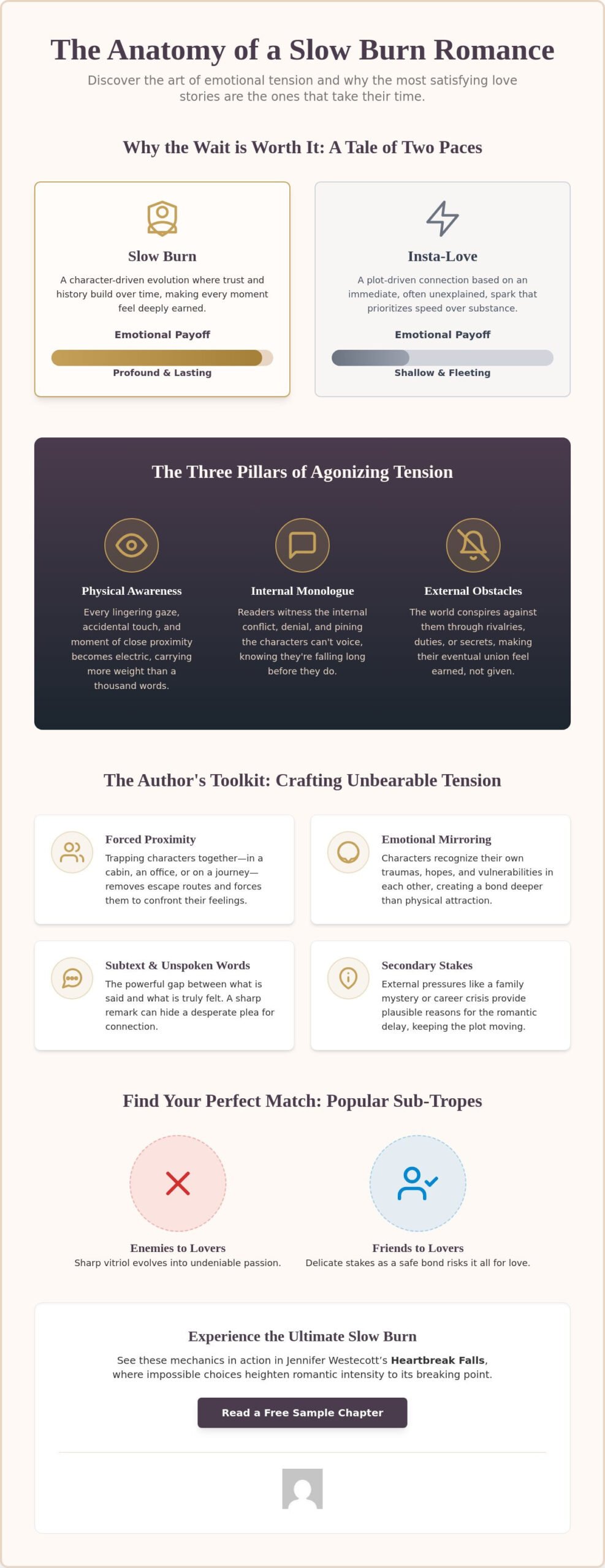
- Understand the fundamental difference between the rush of “insta-love” and the deliberate, character-driven evolution that defines a true slow burn.
- Learn the specific narrative techniques, such as forced proximity and emotional mirroring, that authors use to create a magnetic field of friction.
- Discover why romance books with slow burn tension provide a more profound emotional payoff by ensuring every touch and confession feels deeply earned.
- Identify which sub-tropes, from the sharp vitriol of enemies-to-lovers to the delicate stakes of friends-to-lovers, best suit your personal reading style.
- See these mechanics in action within Jennifer Westecott’s Heartbreak Falls, a story that explores how impossible choices can heighten romantic intensity.
What is a Slow Burn Modern Romance? Defining the Simmer
Think of a slow burn as a masterpiece of restraint. It is not about the destination; it’s about the agonizingly beautiful journey of getting there. Unlike “insta-love,” where characters fall at first sight, romance books with slow burn tension focus on the slow accretion of trust and shared history. The “burn” isn’t a reference to a sluggish plot. Instead, it describes the rising temperature of the emotional stakes. It’s the friction created when two souls are drawn together but kept apart by fear, duty, or circumstance. At its heart, this subgenre lives for “the almost moment.” This is that breathtaking second where breath hitches and fingers brush, yet the characters pull back just before the precipice.
The Key Elements of Slow Burn Modern Romance Tension
In these narratives, silence speaks louder than a shouted confession. Authors use specific common tropes in romance novels to heighten this experience. Every element is designed to make the reader feel the weight of the unspoken. It’s a delicate architecture of desire that relies on three pillars:
- Physical Awareness: Every glance becomes a story. A lingering look or a hand accidentally brushing against a shoulder carries more weight than a thousand grand gestures. The proximity is electric.
- Internal Monologue: This is our window into the pining. We see the denial, the internal conflict, and the desperate hope that the characters can’t yet voice to each other. We know they’re falling long before they do.
- External Obstacles: The world must conspire against them. Whether it’s a family feud, a professional rivalry, or a deep-seated secret, these barriers make the eventual union feel earned rather than given.
Why Readers Crave the Agony of the Wait
Why do we do this to ourselves? The answer lies in the psychological reward of delayed gratification. By the time the characters finally give in, the reader has invested hours into their individual growth and their collective struggle. This creates a bond that fast-paced stories often miss. Real love is rarely a lightning bolt. It’s messy. It’s complicated. It requires time to build a foundation of safety. Romance books with slow burn tension mirror this real-world complexity, making the final payoff feel like a personal victory for the reader. We don’t just want to see them together; we want to feel the relief of the tension finally breaking. It’s a shared emotional experience that lingers long after the final page.
The Anatomy of Emotional Friction: How Authors Craft Unbearable Tension
Creating a slow burn is an exercise in emotional architecture. It requires more than just keeping two people apart; it requires building a magnetic field where the repulsion is as strong as the attraction. Forced proximity is a favorite tool for a reason. When characters are trapped in a cabin, a shared office, or a dangerous journey, they can’t escape the mounting pressure of their own feelings. This constant presence forces them to confront the very things they’re trying to hide. It’s in these cramped spaces that romance books with slow burn tension truly thrive, turning every shared meal or quiet evening into a high-stakes encounter.
Emotional mirroring adds another layer of depth to the “burn.” This happens when characters recognize their own traumas or hopes in the other person. They begin to heal through their shared experiences, creating a bond that goes far beyond physical attraction. This psychological depth is a major part of the appeal of a slow-burn romance. It’s not just about wanting to see them kiss. It’s about wanting to see them whole. Subtext is the heartbeat of this narrative style. It’s the gap between what is said and what is felt. A character might offer a biting remark, but their eyes reveal a desperate need for connection. This dissonance keeps the reader on edge, constantly translating the characters’ true intentions.
Secondary stakes provide the necessary distraction to keep the plot moving while the romance simmers. Whether it’s a professional crisis or a family mystery, these external pressures give the characters a reason to focus on something other than their growing feelings. It provides a plausible excuse for the delay. If you want to see how these elements weave together, you can read a free sample chapter of my work to experience the friction firsthand.
The Power of the Gaze and Sensory Subtext
In a high-tension scene, a single look can replace pages of dialogue. Descriptive language heightens our awareness of a character’s presence; the scent of their cologne, the sound of their uneven breathing, or the way the light catches their eyes. Sensory subtext acts as the bridge between physical surroundings and internal desire. By focusing on these small, visceral details, authors make the reader feel as though they are standing in the room, holding their breath along with the characters.
Vulnerability as the Ultimate Catalyst
The moment a character finally drops their guard is more explosive than any physical encounter. We often discuss emotionally intense romance books because they tap into our deepest fears of being seen. Trust is the final piece of the puzzle. It’s what turns a “slow” story into a “burning” one. When characters move from being wary strangers to vulnerable allies, the tension shifts from a fear of rejection to a fear of loss. This transition is what makes romance books with slow burn tension so addictive; the stakes are no longer just about love, they’re about survival.
Slow Burn vs. Instant Connection: Why the Wait is Always Worth It
Some readers worry that choosing a slow burn means settling for a stagnant plot. That couldn’t be further from the truth. While “insta-love” offers an immediate spark, it often lacks the structural integrity required to support a truly transformative narrative. Romance books with slow burn tension aren’t about delaying the story; they’re about deepening it. In an era of instant gratification, the appeal of a slow-burn romance lies in its counter-cultural insistence that some things are worth the wait. It allows characters to evolve as individuals before they unite as a couple. This makes the genre a perfect vehicle for contemporary love story books that explore difficult personal decisions and the weight of real-world consequences.
The difference between an instant connection and a slow simmer is the difference between a gift and a victory. When attraction is “given” on page one, the narrative often struggles to find a reason for the characters to stay together once the initial heat fades. In contrast, a slow burn is “earned.” It demands that characters confront their shadows and build a bridge of trust over the gaps in their lives. This process creates a relationship that feels indestructible because we’ve seen the work that went into every brick of its foundation.
The “Earned” HEA (Happily Ever After)
The resolution of a slow burn feels like a hard-won triumph. When characters have spent hundreds of pages navigating their own insecurities, past traumas, or conflicting loyalties, their eventual union carries immense emotional weight. Unlike stories where the connection is effortless, a slow burn forces them to build a foundation of mutual respect and friendship first. The period of “pining” isn’t just filler. It’s the crucible where a lifelong commitment is forged. We see them learn each other’s rhythms, flaws, and strengths. By the time they finally reach for each other, we aren’t just watching a romance; we’re witnessing two people who have decided that the other is worth every obstacle they’ve faced.
Managing Pacing and Reader Expectations
A masterfully written slow burn never feels like it’s stalling. The secret lies in the “b-plot.” While the romantic tension simmers in the background, the characters must be active in their own lives. They might be protecting a family, solving a professional crisis, or healing from a personal loss. This external movement provides the necessary narrative drive. You can identify a high-quality “page-turner” by how it handles these secondary stakes. If the characters are only waiting for the author to let them kiss, the story drags. However, if they’re fighting for their futures while trying to ignore the magnetic pull of the other person, the tension becomes unbearable. Narrative momentum is fueled by emotional stakes, not just physical action. When the internal and external conflicts collide, the result is a story that keeps you reading until the early hours of the morning.
Finding Your Perfect Match: Sub-Tropes That Master the Slow Burn
Not all burns are created equal. The specific sub-trope an author chooses acts as the catalyst for the friction, determining whether the story feels like a gentle simmer or a volatile explosion. While some readers believe enemies-to-lovers is the only path to high stakes, other narrative frameworks offer equally compelling reasons for delay. Understanding these archetypes helps you curate your library to include the specific romance books with slow burn tension that resonate with your emotional triggers. Each flavor of tension offers a different psychological reward.
Enemies-to-lovers is perhaps the most visceral example of this. It relies on a fine line between passion and vitriol. The characters are already obsessed with each other, even if that obsession is fueled by anger. This intense focus makes the eventual shift toward romance feel like a natural extension of their existing connection. In contrast, friends-to-lovers explores a more delicate fear. The stakes here are the potential loss of a lifelong safety net. The tension arises from the silent question: is the risk of losing a friend worth the chance at finding a soulmate? It’s a terrifying gamble that keeps the reader held in suspense.
Forbidden love and second chances provide a different kind of architectural delay. In forbidden romance, the wait is often mandatory because the external stakes are too high to ignore. When we look at romance novels about starting over, we see how history itself becomes a tension builder. The characters aren’t just fighting their current feelings; they’re fighting the ghosts of who they used to be. This shared past creates a unique resonance. It makes every tentative step forward feel monumental because it requires letting go of a previous life.
The Impossible Choice: When Love and Duty Collide
External pressures often force a slow burn by presenting characters with a moral dilemma. Whether it is family loyalty, a high-stakes career, or a secret that could destroy their world, these obstacles make the choice to be together feel impossible. These choices are the ultimate test. They ensure the characters have to sacrifice something significant to earn their happy ending. If you’re looking for a story where the stakes feel truly personal, you can explore my collection of high-tension romance to find your next obsession.
Identifying Your “Tension Type”
Finding the right book requires knowing what makes your heart race. Do you prefer the sharp banter of a grumpy/sunshine dynamic or the quiet ache of mutual pining? Most digital platforms allow you to search by these specific tags. Checking the “heat level” is also vital. Some slow burns focus entirely on emotional intimacy, while others use the delay to build toward an explosive physical payoff. Knowing your preference ensures the wait feels like a pleasure rather than a chore. It turns the reading experience into a bespoke emotional journey tailored to your specific tastes.
Experience the Ultimate Tension in Jennifer Westecott’s Heartbreak Falls
If you have ever felt the ache of a story that refuses to rush, you understand why Heartbreak Falls has become a touchstone for readers who seek romance books with slow burn tension. This novel is a masterclass in restraint. It takes the theoretical mechanics of the “simmer” and breathes life into them through characters who are as guarded as they are desperate for connection. The atmospheric setting of the town itself, with its rugged beauty and sense of isolation, serves as a mirror for the characters’ internal struggles. Every shadow in the woods and every cold breeze off the water heightens the magnetic pull between two people who are terrified of what happens if they finally let go. Jennifer Westecott’s writing is defined by impossible choices. It isn’t just about whether the characters will be together, but what they must sacrifice to make that union possible.
Why Heartbreak Falls Resonates with Slow Burn Fans
The power of this story lies in its deep emotional arc. We don’t just see the characters fall in love; we see them heal. Each protagonist carries a fractured history that makes trust a high-stakes gamble. The prose is sophisticated and evocative, designed to make you feel the weight of every unspoken word. It’s a narrative that balances the sharp sting of heartbreak with the glowing hope of a hard-earned connection. Readers who are tired of superficial arcs will find solace in the way Westecott treats every “almost moment” with the reverence it deserves. This is not a story that gives away its secrets easily. It requires you to linger in the tension, making the eventual payoff feel like a personal victory for anyone who has ever waited for the right moment.
Begin Your Journey into the Simmer
Jennifer Westecott’s work is specifically for those who crave stories that feel real. These are not sanitized romances; they are visceral, high-stakes journeys through the complexities of the human heart. If you are ready to experience the pining and passion firsthand, you can download a Free Sample Chapter to test the tension for yourself. See how the subtext builds and how the sensory details pull you deeper into the world of Heartbreak Falls. Don’t settle for a story that rushes the flame. Instead, choose a narrative that understands the beauty of the burn. Explore the world of Jennifer Westecott and find your next unforgettable read.
Embrace the Agony of the Wait
True romantic intensity is never found in a rush. It is built in the quiet spaces between words and the high-stakes decisions that test a character’s soul. By understanding the anatomy of friction and identifying the sub-tropes that speak to your heart, you can curate a library of romance books with slow burn tension that deliver more than just a story; they deliver an experience. We’ve explored how forced proximity and impossible choices transform a simple plot into a visceral journey of healing and desire.
If you’re ready to trade predictable arcs for evocative storytelling that resonates with deep emotional pining, it’s time to dive into a world where every touch is earned. Jennifer Westecott’s literary romance focuses on the difficult paths we take to find true connection. You can start reading Heartbreak Falls with a free sample chapter today and feel the simmer for yourself. Free previews are available for all readers who crave a narrative that feels as real as it is dramatic. Don’t settle for the spark when you can have the entire fire. Your next unforgettable read is just a page turn away.
Frequently Asked Questions
What is the difference between a slow burn and a “clean” romance?
Slow burn describes the narrative pacing and emotional buildup, whereas “clean” romance refers to the absence of explicit sexual content. A story can be a slow burn and still be highly explicit once the characters finally give in. Conversely, it can be a closed-door “clean” read. The defining factor is how long the characters wait to act on their feelings, regardless of the heat level.
How many pages does a typical slow burn romance book take to reach the “payoff”?
Most slow burn novels reach their first major romantic milestone in the final 20% to 25% of the story. For a 350-page novel, this usually happens around page 270 or later. This specific pacing ensures the emotional bond is fully established and the trust is earned before the physical connection takes place. It turns the eventual payoff into a significant narrative event.
Can a slow burn romance also be an enemies-to-lovers story?
These two tropes are frequently combined because deep-seated animosity provides a logical barrier to an immediate relationship. Many romance books with slow burn tension use the enemies-to-lovers framework to sustain a high-friction environment where every interaction feels like a battle of wills. The transition from hatred to love requires significant character growth, which naturally extends the timeline of the romance and keeps readers on edge.
Why do authors use “forced proximity” in slow burn novels?
Authors use this technique to strip away a character’s defenses by making physical escape impossible. When characters are trapped in a snowed-in cabin or a shared workspace, they’re forced to interact despite their reservations. This constant exposure accelerates their emotional intimacy while heightening the physical awareness between them. It creates a “pressure cooker” environment where the characters can’t ignore the magnetic pull they feel.
What are some signs that a romance book will have good slow burn tension?
Strong subtext in dialogue and a focus on micro-gestures are the most reliable indicators of a quality read. If you notice a character’s internal monologue is consumed by the other person’s smallest movements or the sound of their breath, you’ve found romance books with slow burn tension that prioritize emotional depth. Good tension relies on what isn’t said, making every small touch feel like an electric shock.
Is a slow burn romance suitable for readers who prefer high-stakes drama?
It is the perfect fit for high-stakes stories because external chaos justifies the romantic delay. When characters are busy surviving a professional crisis or a dangerous mystery, their inability to focus on their feelings feels organic rather than forced. This creates a unique dynamic where the romance simmers in the background of a fast-paced plot. The high stakes make the characters’ eventual vulnerability even more powerful.
Are slow burn books usually part of a series or standalones?
Slow burns are common in both standalones and series, though the pacing differs slightly between them. In a standalone, the tension must resolve by the final chapter. In a series, an author might choose to stretch the “will-they-won’t-they” dynamic across several installments. This allows for even deeper character evolution and world-building, as the reader watches the bond strengthen through various challenges over a longer period.
How does Jennifer Westecott build tension in her novels like Heartbreak Falls?
Westecott builds tension by forcing her characters to face moral dilemmas and impossible choices that test their loyalties. In Heartbreak Falls, the rugged setting and the weight of past secrets create a visceral sense of pining that feels grounded in reality. Every interaction is layered with the fear of vulnerability and the hope of healing. She uses sensory details to make the characters’ physical awareness of each other feel unavoidable.