
What if the end of your marriage wasn’t the closing chapter, but the necessary destruction required to build something truly beautiful? It’s a question many of us ask when life takes a sharp, unexpected turn. You’ve likely felt the frustration of reading romance novels about starting over where the protagonist’s transformation feels too easy or unearned. You want more than a simple change of scenery. You crave the grit, the vulnerability, and the slow, aching process of finding yourself before you ever find someone else.
I understand that deep-seated need for stories that mirror the complexity of real life. We’re going to explore why these narratives of emotional rebirth resonate so deeply and help you discover your next favorite story of new beginnings. From the high-stakes emotional tension in Jennifer Westecott’s Heartbreak Falls to the quiet, healing power of an overgrown garden, this guide previews the best books that balance personal growth with breathtaking romance. You’ll find authors who write characters as complex and resilient as you are.
Key Takeaways
- Redefine the “fresh start” trope as a profound emotional rebirth that goes far deeper than a simple change of address or scenery.
- Explore the diverse sub-tropes within romance novels about starting over to find a narrative that mirrors your own path toward healing and hope.
- Identify the hallmarks of a truly impactful story, including the vital “Dark Night of the Soul” that makes a character’s eventual growth feel earned and authentic.
- Learn how to filter your next read by life catalyst and heat level to ensure the story meets your specific emotional and narrative cravings.
- Discover why Heartbreak Falls serves as a masterclass in how impossible choices and high-stakes tension lead to the most rewarding second acts.
The Catharsis of the Fresh Start: Why We Crave Stories of Starting Over
Starting over is a quiet, violent act of hope. It isn’t just about packing a suitcase or moving to a sun-drenched town with a single stoplight. For many, romance novels about starting over represent a profound emotional rebirth. It’s the moment when the protagonist realizes that their old life is no longer a fit, like a coat that has become too tight across the shoulders. In 2026, as the world feels increasingly unpredictable, readers are turning to these stories to find proof of their own resilience. We don’t just want a happy ending. We want to see the character survive the wreckage first.
There is a distinct difference between a “second chance” story and a “fresh start.” While a traditional romance novel often focuses on rekindling an old flame with a former lover, a fresh start is about the terrifying, exhilarating blank page. It’s not about going back to what was comfortable; it’s about walking into the unknown. This fulfills a universal human desire for a do-over. It’s a chance to shed our mistakes and begin again with the wisdom we’ve hard-earned through pain.
The Psychological Appeal of the Clean Slate
These stories resonate because they mirror the actual stages of grief and recovery. We watch characters navigate the messy middle of healing, where progress isn’t linear and old ghosts still haunt the hallways. The most compelling narratives prioritize agency. The protagonist must choose themselves, their own peace, and their own future before they can ever truly choose a partner. This makes the eventual romance feel like a hard-won reward for their growth rather than a simple cure for their problems. It’s about being whole before becoming half of a pair.
Escapism vs. Realism in Modern Romance
Modern readers demand a delicate balance between the “dreamy” escapism of a new life and the jagged reality of personal baggage. We’re tired of instant healing and perfect heroes who have no flaws. We want characters who have scars that itch when it rains. In Heartbreak Falls, Jennifer Westecott masterfully balances this tension. She doesn’t shy away from the difficult personal decisions that define a life’s second act. Her characters face high-stakes passion, but it’s grounded in the authentic weight of their pasts. This realism makes the escapism feel earned, proving that even in the midst of chaos, a new beginning is always within reach.
Beyond the Small Town: Popular Sub-Tropes of Starting Over
The terrain of a fresh start is as varied as the hearts that brave it. While many stories find their pulse in the quiet rhythm of a quaint village, romance novels about starting over are increasingly exploring the grit of urban centers and the sharp edges of professional reinvention. We’re seeing a shift because romance is zeitgeisting, moving into sophisticated spaces that demand more than just a change of zip code. It’s about the identity we shed and the one we tentatively try on. Whether it’s a “Big City Rebirth” where anonymity offers a shield or a “Career Pivot” that forces a character to find their worth outside a boardroom, these narratives prove that a new life can take root anywhere.
The Small Town Sanctuary
There’s a reason the small town remains a staple. It offers a specific, visceral kind of healing. It’s the stark contrast between the cold, sterile silence of a previous life and the warm, sometimes intrusive, embrace of a community. Found families provide a safety net that allows a character to stumble without falling. You’ll often see the protagonist move from a place where they were invisible to a town where their every move is cataloged by nosy but deeply caring neighbors. The danger here is the “perfect” town cliché. A truly compelling story avoids the trap of the instant fix; it acknowledges that even in paradise, the internal work of recovery is grueling. Real growth requires the friction of being known again.
The Emotional Relocation
Perhaps the most difficult path is the one where the protagonist doesn’t move at all. Emotional relocation is the art of staying in the same house but becoming a different person. It requires facing the same ghosts every day while refusing to be haunted. These stories focus on the internal transformation and the impossible choices involved in dismantling a life from the inside out. Characters must navigate existing social circles that no longer fit and family dynamics that feel like cages. It’s a high-stakes journey of the mind. If you’re looking for a story that captures this raw transition, you might want to read a free chapter of a novel that explores these themes with unflinching honesty. This sub-trope reminds us that the most significant distance we ever travel is the space between who we were and who we choose to be.
Emotional Depth vs. Surface Clichés: What Makes a Fresh Start Novel Work?
Too many stories treat a fresh start like a filtered Instagram post. The protagonist moves, buys a charming fixer-upper, and meets a perfect partner by page fifty. It’s hollow. It’s unearned. Readers are increasingly tired of this “instant healing” and the trope of the flawless hero who has no internal work to do. A truly resonant story acknowledges that the psychological appeal of starting over lies in the struggle itself. We don’t want the magic wand; we want the grit of the transformation. This is why the “Dark Night of the Soul” is a non-negotiable element in romance novels about starting over. Without that moment of total uncertainty, the eventual joy lacks weight.
The most impactful narratives follow the Jennifer Westecott approach. Her characters are messy, flawed, and deeply human. They face real-world consequences for their choices. In this framework, the romance is never the cause of the character’s growth. Instead, it is the result of it. The protagonist must do the heavy lifting of reclaiming their identity first. Only when they are standing on their own two feet does the love interest become a partner rather than a crutch. This shift in focus creates a narrative that feels authentic and deeply cathartic.
The Necessity of the Impossible Choice
True growth requires sacrifice. To build something new, a character must usually give something up that they once held dear. This creates a sharp tension between the safety of the past and the terrifying potential of an uncertain future. Whether it’s walking away from a lucrative career that burned them out or leaving a social circle that no longer understands them, these impossible choices define the character’s arc. High-stakes decisions elevate the payoff. When they finally find happiness, we know exactly what it cost them to get there.
Vulnerability as a Superpower
Trusting someone new after you’ve been burned is an act of extreme bravery. It is the ultimate hurdle in a second-act romance. In the context of contemporary love stories, emotional vulnerability is the courageous decision to be seen in your entirety, including the jagged edges and the scars you’d rather hide. We root for characters who are terrified but choose to move forward anyway. Their fear doesn’t make them weak; it makes their eventual surrender to love a profound victory. It’s the strength found in the wreckage that keeps us turning the pages.
How to Find Your Perfect ‘Starting Over’ Read in 2026
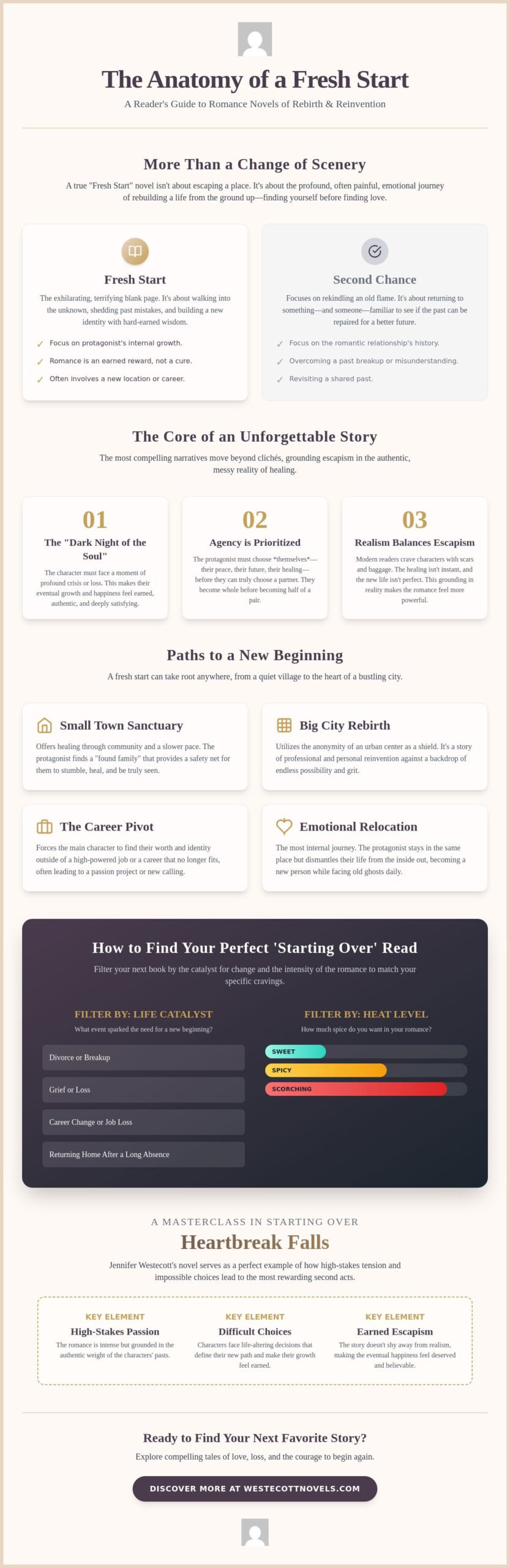
Finding the right book is like finding a mirror. It shouldn’t just tell a story; it should reflect your current emotional state. When you’re scouring the shelves for romance novels about starting over, the first step is to identify your specific catalyst. Are you looking for a narrative centered on the wreckage of a divorce, the terrifying void of a career change, or the quiet, heavy ache of loss? Each of these starting points requires a different emotional frequency. A story about a high-powered executive fleeing to a farm offers a different kind of catharsis than a widow finding the courage to open her heart again. Match the protagonist’s struggle to your own need for resolution.
You must also consider the “heat level” that fits your mood. Some readers crave a slow-burn emotional journey where the tension builds like a summer storm. Others want intense passion that mirrors the high stakes of a life in transition. If you’re looking for community-driven healing, seek out “Found Family” tags. These stories emphasize that a fresh start isn’t just about a partner, but about the network of people who help you rebuild. For those tired of predictable plots, Indie Romance often provides fresher perspectives and unconventional character arcs that mainstream publishers might overlook. It’s where the most daring emotional risks are often taken.
A Checklist for Your Next TBR
To ensure your next read has the depth you deserve, ask yourself these questions before diving in:
- Does the protagonist have a life outside of the hero? A character who exists only for the romance isn’t starting over; they’re just changing owners.
- Is the conflict internal or external? While villains add drama, the most resonant fresh start stories focus on the internal fear of being known again.
- Does the ending feel earned? The resolution should be a direct result of the character’s evolution, not a lucky accident or a convenient plot twist.
Where to Start Your Journey
The best way to gauge emotional resonance is to test the waters. Reading sample chapters allows you to feel the rhythm of the prose before you commit your heart to the story. It’s an essential step in finding a voice that speaks to your specific brand of “starting over.” You can begin your search by exploring the free sample chapters of Heartbreak Falls to see if the emotional weight matches what you’re looking for. Additionally, use reader reviews on platforms like BookTok to gauge the “angst level.” Look for mentions of the “Dark Night of the Soul” to ensure the story won’t shy away from the difficult parts of the journey.
Dive into a new beginning today by exploring free sample chapters of Heartbreak Falls and discover a story that understands the complexity of a second act.
Heartbreak Falls: A Masterclass in Love and Starting Over
Some stories are read; others are felt in the marrow of your bones. Jennifer Westecott’s Heartbreak Falls stands as a definitive masterclass in the genre, offering a visceral look at the wreckage and the subsequent rebuilding of a life. While many romance novels about starting over lean into the comfort of a new setting, this novel dives headfirst into the jagged reality of what is left behind. It’s a high-stakes journey where every step forward is shadowed by the weight of a previous life. Westecott doesn’t offer easy answers. Instead, she presents characters who must face the impossible choices that define a true second act.
The narrative pulse of the book is a delicate dance between intense, breathless passion and the slow, methodical process of emotional recovery. It understands that healing isn’t a straight line. It’s a series of stumbles and small victories. This balance makes the story a relentless page-turner. You aren’t just reading for the “happily ever after.” You’re reading to see if the protagonist can survive the internal storm long enough to reach the shore. It is a story that lingers, haunting your thoughts long after the final page is turned.
Passion Meets Difficult Choices
In Heartbreak Falls, the central conflict isn’t just about finding a new partner. It’s about the agonizing tension between desire and duty. The characters are forced to navigate the messy overlap of their past obligations and their new, terrifying hopes. This isn’t a surface-level “beach read.” It is a sophisticated piece of contemporary fiction that balances literary depth with raw, high-stakes romance. It appeals to readers who want their love stories to feel as complex and demanding as real life. Every kiss is earned. Every moment of vulnerability is a hard-won victory over the fear of being hurt again.
Join the Westecott Reader Community
When you read a Westecott novel, you aren’t just a consumer; you’re part of an intimate community of story lovers who value emotional honesty and narrative tension. This exclusive circle is where we celebrate the resilience of the human heart and the beauty of finding love when you least expect it. It’s a shared journey through the most difficult personal decisions and the most rewarding emotional payoffs. If you’re ready to see how a true fresh start feels, I invite you to explore more of this evocative portfolio. Your next favorite story is waiting to be discovered.
Dive into Heartbreak Falls or read a free sample today to begin your own journey of emotional rebirth.
Embrace the Power of Your Second Act
A fresh start is never just a change of scenery. It is a grueling, beautiful dismantling of the old to make room for the new. We’ve explored how the most resonant romance novels about starting over move beyond simple tropes to embrace the messy reality of healing. By prioritizing internal growth and the weight of impossible choices, these stories offer more than just an escape. They provide a roadmap for resilience. You deserve characters who are as complex and courageous as you are, facing life’s second act with unflinching honesty and sophisticated passion.
If you’re ready to lose yourself in a world where every moment of vulnerability is earned, now is the time to take that first step. Start your next emotional journey with a free sample of Heartbreak Falls. Discover why Jennifer Westecott’s focus on deep emotional stakes and sophisticated contemporary romance is the perfect fit for the modern reader. Your next favorite story is just a page away. Believe in the possibility of your own new beginning, and let these narratives remind you that it’s never too late to be known again.
Frequently Asked Questions
What is the ‘starting over’ trope in romance novels?
The starting over trope represents a character’s profound transformation after a major life upheaval. While it often involves a physical move, the core of the story is the emotional reclamation of one’s identity. In romance novels about starting over, the protagonist must dismantle their old life to build a future that finally fits their true self. It’s about the courage required to be vulnerable again after the world has shifted beneath your feet.
How do fresh start romances differ from second chance romances?
Fresh start romances focus on entirely new beginnings with a new partner, whereas second chance romances revolve around rekindling a relationship with a former lover. A fresh start is a terrifying blank page. It demands that the character leave the past behind to discover a love they never imagined. Second chance stories are about fixing what was broken. Fresh starts are about building something that never existed before.
Are there romance novels about starting over that aren’t set in small towns?
Absolutely, many modern narratives take place in bustling urban centers or involve characters staying in their current environment while undergoing an internal metamorphosis. A “Big City Rebirth” offers the shield of anonymity, while a “Career Pivot” uses professional reinvention as the catalyst for love. Starting over is a state of mind. You don’t always need a new zip code to find a new version of yourself.
Why are romance books about starting over so popular right now?
These stories resonate because they mirror the real-life resilience required to navigate an increasingly unpredictable world. Readers crave the catharsis of watching someone survive a personal collapse and emerge stronger. In a time of global and personal uncertainty, seeing a character make difficult decisions and find joy again provides a powerful sense of hope. It’s proof that a second act is always possible.
Can a romance novel about heartbreak actually be uplifting?
Heartbreak is the necessary soil where an uplifting romance grows. The eventual joy feels more profound because it was hard-won through struggle. When a character faces their “Dark Night of the Soul” and chooses to move forward, the romantic payoff becomes an earned victory. These stories aren’t just about the pain. They are about the breathtaking strength found in the wreckage.
What makes Heartbreak Falls different from other starting over novels?
Heartbreak Falls distinguishes itself by focusing on impossible choices and the raw consequences of starting over. Jennifer Westecott crafts characters who aren’t just looking for a quick fix; they are navigating the tension between their desires and their duties. It avoids surface-level clichés in favor of deep emotional stakes and a sophisticated narrative. This makes the passion feel more intense because the characters have so much to lose.
Where can I find free samples of contemporary romance novels?
You can access a Free Sample Chapter for many contemporary titles directly through author websites. For a story that balances high-stakes tension with emotional rebirth, you can explore the opening pages of Heartbreak Falls at westecottnovels.com. Testing the rhythm of the prose helps you ensure the emotional frequency matches what you’re looking for in your next read. It’s the best way to find a voice that speaks to you.
How do I choose between a slow-burn or high-intensity romance?
Your choice depends on the emotional frequency you crave. A slow-burn romance builds tension like a gathering storm, focusing on the gradual process of healing and trust. High-intensity romances mirror the urgent, high-stakes nature of a life in sudden transition. Consider your current catalyst. If you want to linger on the internal work of recovery, choose a slow-burn. If you want the thrill of immediate connection, go for high-intensity.